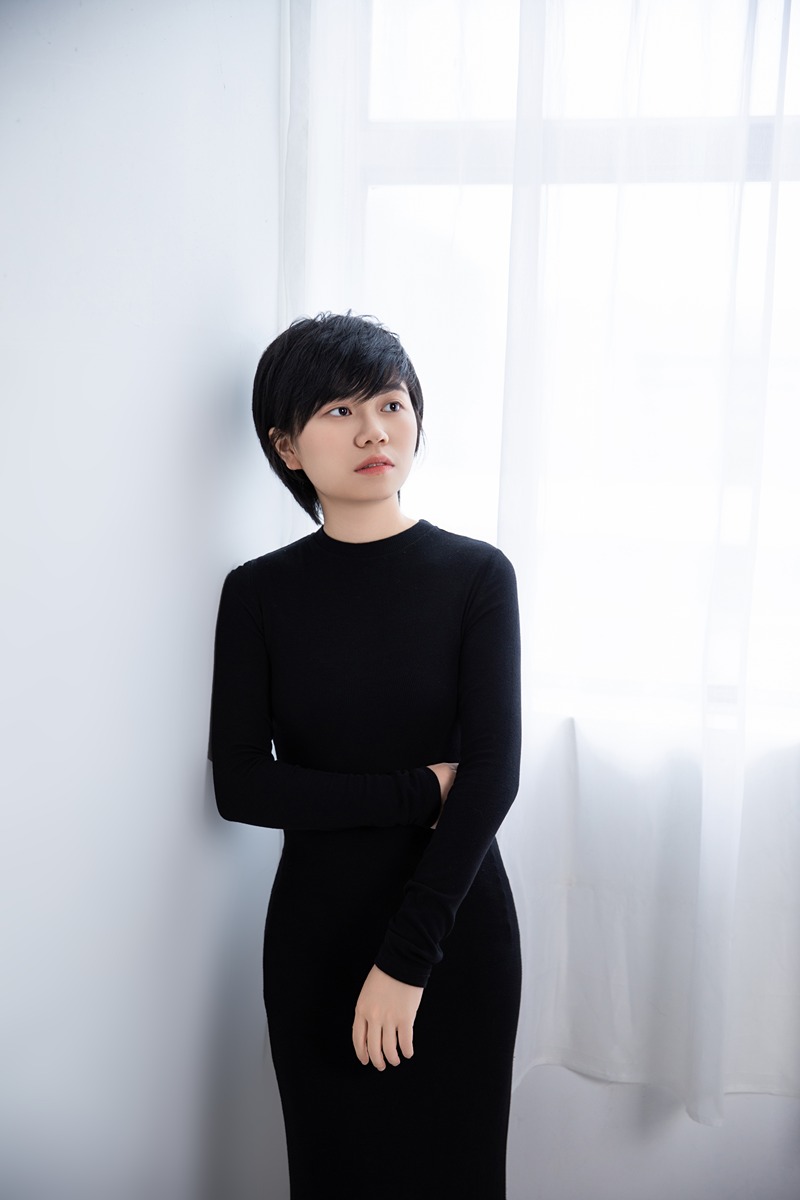
Originally from Shenzhen, China, Yuxuan Lin (b. 2003) is a New York–based composer and interdisciplinary artist whose work explores the intersections of music, technology, visual art, movement, and neurological diversity. Drawn to collaborative and cross-disciplinary forms of creation, Lin is particularly interested in how computational tools and interactive technologies can expand musical thinking beyond conventional modes of composition and performance. Her artistic practice is informed in part by her distinctive way of perceiving space and distance, leading her to consider neurological diversity not as a limitation, but as a source of alternative artistic knowledge and creative possibility.
Beginning with piano at age six, Lin’s musical journey soon expanded across traditions, from folk and classical guitar to the Chinese instruments erhu and hulusi. In her late teens, Lin began her formal composition studies with Reiko Füting, following in the footsteps of her grandfather, a self-taught composer whose work centered on Chinese folk music. Lin’s musical background across Western and Chinese instrumental traditions has since developed into a practice increasingly concerned with the relationships among sound, space, physical gesture, image, and technology.
As a composer, Lin has collaborated with and had her music recognized by a wide range of contemporary music ensembles and organizations, including Talea Ensemble, The Rhythm Method, Salastina, SOLI Chamber Ensemble, Society for New Music, ASCAP, and OLEA ensemble, among others. Lin is the winner of the 2024 Verdehr Trio Composition Commission Prize and the 2023 New Voices in Art Song Series Competition, with her work also selected through numerous competitive calls for scores across the United States. Published by North Star Music LLC, Lin’s music has reached audiences across North America, Asia, and Europe, with performances at venues such as Alice Tully Hall in New York, La Schola Cantorum in Paris, Seocho Art Center in Seoul, the Tokyo to New York benefit concert, and beyond.
Lin’s development as a composer has also been shaped by participation in programs and festivals including the European American Musical Alliance (EAMA), Yellow Barn Young Artists Program, Atlantic Music Festival, Bowdoin International Music Festival, Lake George Music Festival, New Music On The Point, and SPLICE Institute, where she further pursued her interests in electroacoustic music and technology. As a member of the Salastina Composer Collective, she worked with composer Derrick Skye. Across these programs and her broader musical training, Lin has had the opportunity to work with and learn from renowned composers including Tania Leon, Amy Williams, Andrew Norman, Kevin Puts, Derek Bermel, George Tsontakis, Alyssa Weinberg, Eric Nathan, Stephen Coxe, Ana Sokolović, Matthew Quayle, and many others.
Lin's interest in interdisciplinary work extends beyond concert composition. As an avid composer for visual media, she has collaborated with filmmakers and has been partnered with student directors at the London Film School on multiple projects. Increasingly, however, technology has become not simply a medium through which she presents music, but an integral part of how she conceives of artistic structure itself. Her recent work investigates creative coding, electronic and spatial audio, motion-responsive performance systems, and the translation of physical gesture and perceptual information into musical behavior. She has developed sensor-driven performance systems in Max, mapping live performers’ movements to sound spatialization, dynamics, timbral transformation, and visual imagery. Her technological practice is accompanied by an ongoing investment in programming and computational thinking. Alongside her conservatory training, Lin has pursued independent study in computer science, with a focus on programming and creative computation, building creative coding environments for music and interactive media. Rather than approaching technology as separate from her identity as a composer, she is interested in the point at which artistic intuition and technical systems become inseparable, where an algorithm, sensor mapping, software environment, or spatial-audio architecture can itself become part of the compositional material. This continuing exploration has led her toward questions surrounding human-computer interaction, machine learning, interactive performance, audiovisual installation, and emerging forms of technologically mediated artistic expression.
Underlying these interests is Lin's sustained fascination with perception. Her distinctive experience of perceiving space and depth has encouraged her to investigate how different perceptual realities might invoke different artistic structures and narratives. In interdisciplinary and multimedia projects, Lin has explored relationships among visual parallax, sonic depth, spatialized sound, and artificial constructions of perspective. At the current stage, Lin is interested in the broader question of how technology can help translate perceptual experiences into artistic forms through sound, movement, and interaction without reducing them to explanation.
Lin received her Bachelor of Music in Composition from The Juilliard School, where she was awarded the Peter Mennin Prize for outstanding achievement and leadership in music, presented at commencement by David Serkin Ludwig, Dean and Director of the Music Division. She subsequently continued at Juilliard as a Master of Music candidate in Composition, studying with Melinda Wagner, Nina C. Young, David Ludwig, and Amy Beth Kirsten.